|
|
As you work down this page through the drills,
you will gradually put all the pieces of the running action together
as described in the Running Technique
section of the site. In that section you will see that we have
described the five parts of the running technique - so here we have
put numbers against each drill relating to the part of the technique
that we are aiming to improve.
|
The way to view these "movies" is to click on
the image and your browser will load it into the appropriate
software. They are not 100% clear, but should be more than adequate
to see how to perform the respective exercises. We have done this
in order to keep the file size down, meaning that with a standard
modem, these files should usually download within a minute.
|
 |
Step Over Drill (1)
Although this is a very simple looking drill, it is one of the harder ones to master. The
aim is to use the muscles on the lower front part of your leg to lift your foot and decrease the
angle between your foot and lower leg as soon as your foot leaves the ground.
The drill uses very small steps where you lift the foot over the ankle bone before lowering
it back to the floor - in terms of range of movement it is similar to that used to pedal a
bike.
One way to help athletes achieve this is to stand behind them and ask them to not let you see
the soles of their shoes as soon as their feet leave the track.
We have included both the side view of this exercise and also one from behind to give you some
idea of what you should be aiming at.
|
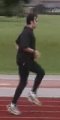
Step Over Video (side view)
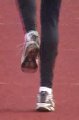
Step Over Video (back view)
|
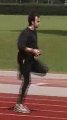
Single Leg Drill Video |
Single Leg Drills (1,2,3)
Here we are concentrating on just one leg (the other one will just follow - or you'd fall
over!). This is a 3 part action, succintly put as "Toe up, Heel up, Knee up". So, as you
take off the ground, you lift your foot to create the small angle as above. Then, pull your
heel in a straight line up to your backside (this is the quickest route after all).
Once it is there, then bring your knee through to the highest position it will reach when
you are running - this should be just below the level which would bring your upper leg
parallel with the ground.
Once in this position, drop your foot back to the ground and start again.
|
Straight Legs Drill (1,5)
At first sight this looks a slightly strange drill, but it is very
useful for the two parts of the running action at the beginning and end of each stride. The
aim is to run, on your toes, with your legs straight (but NOT locked at the knees). Keep the
upper part of your body straight, but leaning forward slightly at the hips.
We do this drill for two reasons. Firstly, it teach you to pull your foot up (decreasing the angle
between foot and shin - as mentioned before), because if you don't you'll simple stub your toes
on the track (and that hurts!).
Secondly, it teaches you to claw back at the end of each stride, by pulling your foot back
and therefore you foot contacts with the ground behind your centre of gravity, avoiding the
braking action that would otherwise occur.
|
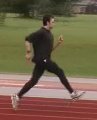
Straight Legs Drill Video |
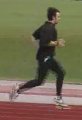
Bum Flick High Knees Drill Video |
Bum Flick High Knees Drill (1,2,3) + Run Off (4,5)
This is hopefully where we put all the parts of the running action
together. The Bum Flick High Knees are fairly self-explanatory. The action is similar to
that of the single leg drill, but you are performing it on every stride. Follow the same
routine as before of "toe up, heel up, knee up", whilst the upper part of your body remains
relaxed and slightly leaning forward.
When you have run about 30m then gradually turn this into the full running action as this
will show you the importance of the first 3 phases.
|
|
There are many variations that can be done on these drills. We will
be adding further ones in the future. This will allow you to improve your action and also
avoid stagnation, which often comes when athletes go into auto-pilot to do the drills that
they have been doing week-in week-out for years, with no concentration at all and ultimately,
very little improvement in technique.
|
|


